
My Philosophy
I believe effective instructional design centers the learner, providing opportunities for them to reflect, make connections, struggle productively, and access content in a fashion suited to each individual. My approach to educational technology helps affirm this, with technology acting as a tool to support their learning instead of replacing it.
When I say ‘center the learner’ I mean beginning instruction from who the learner is and what they’re ready to do. I used to believe I had to design curriculum or courses from the content and then work towards the learner. I’ve flipped this process for my instructional design, beginning with the learner and what they need, then designing from there.
I have organized this philosophy into four specific parts: designing for connection, managing cognitive load, learning through struggle, and supporting learner variability through accessibility. Each part is essential to my instructional design practice so I can commit to centering any learner, whether they’re K-12 or an adult.
Designing For Connection
The first part of my philosophy is designing for connection. This learning design theory comes from George Siemens, who argues that learning in the digital age depends less on acquiring information and more on developing connections between information, people, and resources (Siemens, 2005). I apply this connectivist approach when aligning my materials to objectives across coursework and by creating opportunities for peer-to-peer engagement. The cross lens discussion I created for my capstone course, ‘Exploring IB-Thought through Text’ is a great example of this. In the Module 2 discussion, students are required to evaluate competing perspectives using AI. Students use a prompt I give them to generate two competing readings of the same text through different concept lenses. While technology helps support this, students must rely on their own analysis to decide which lens produced the stronger reading, treating AI as a starting point.
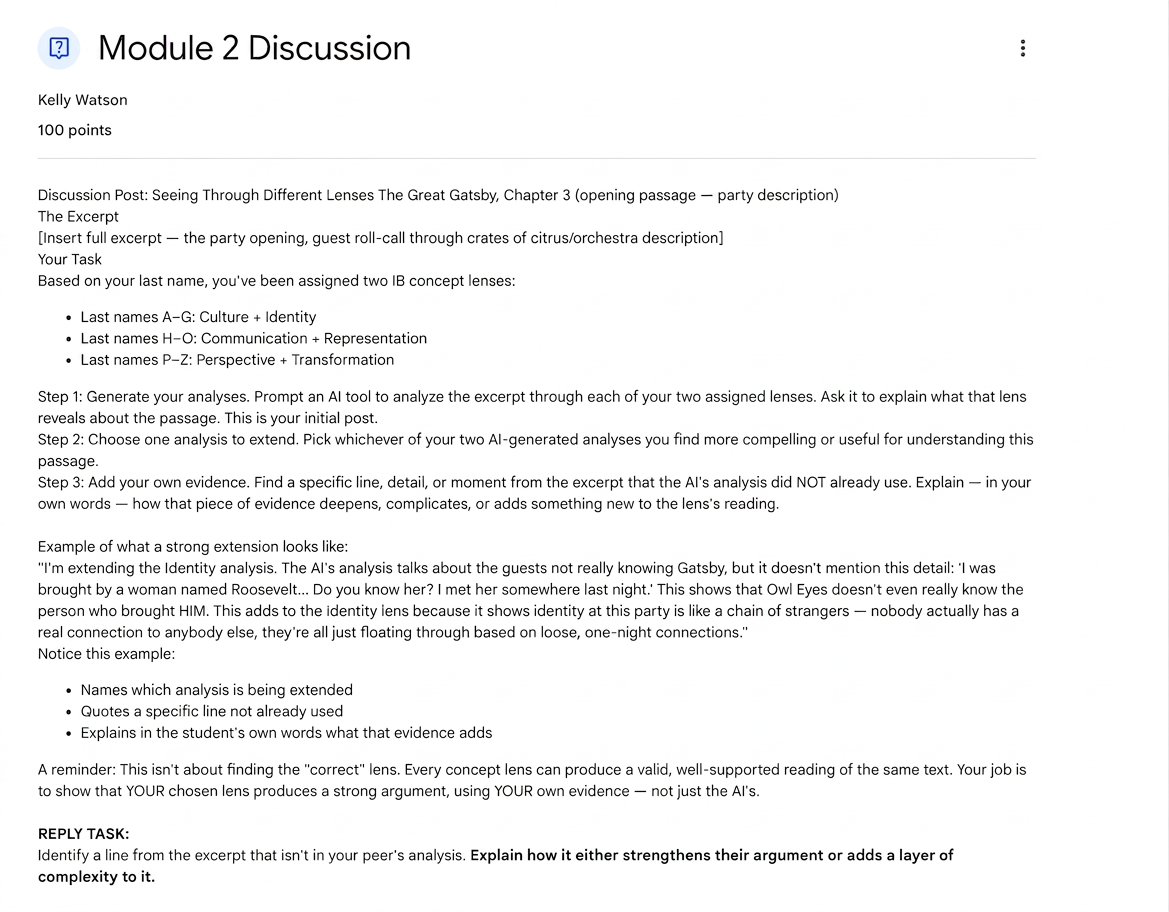
Cross-Lens Discussion Activity
Screenshot of the AI-assisted Cross-Lens Argument discussion board.
Note. Students generate two lens-based readings of the same text and evaluate which produced the stronger analysis.
I extended this same connectivist idea into the courses module 3 discussion activity. After students complete their formative in module 2, they post this document to a discussion board. In the formative, students create a visual text using authorial choices to illustrate a message. After posting the formative, each student in the class must respond to one peer, by turning their formative into the first part of the module 3 summative concept map. They add a second text they believe shares the same message, and the original student finishes their concept map, choosing whether to build on that branch. The learning depends on a network of other students’ thinking as well as the content. Each student begins their summative from an interpretation they must evaluate and accept or adapt. I’m able to center the learner by designing the conditions that let them connect, question, and apply knowledge.
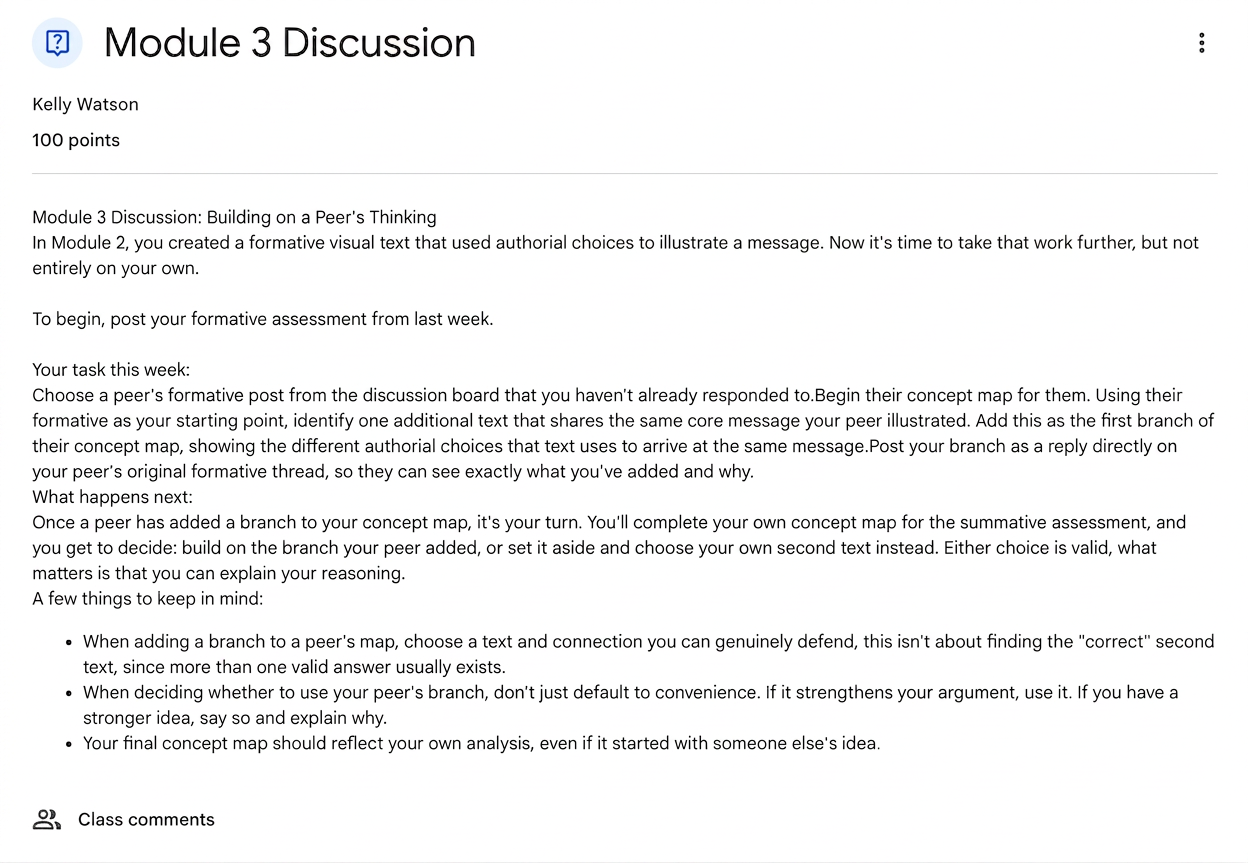
Module 3 Concept Map Handoff
Screenshot of the peer discussion post beginning a classmate’s summative concept map.
Note. A peer adds a branch to a classmate’s formative work before the original student completes their own concept map.
Managing Cognitive Load
The second part of my philosophy is based on managing cognitive load, where I shape how my content reaches the learner. Clark and Mayer argue that effective multimedia instruction requires attention to cognitive load, organization, and signaling (Clark & Mayer, 2023). I applied this directly in the LMS design of my Capstone course and specifically in my “authorial choice toolkit”. I structured a Google Doc using tabs to chunk the material into explicit sections, reducing how much the learners had to process at once.
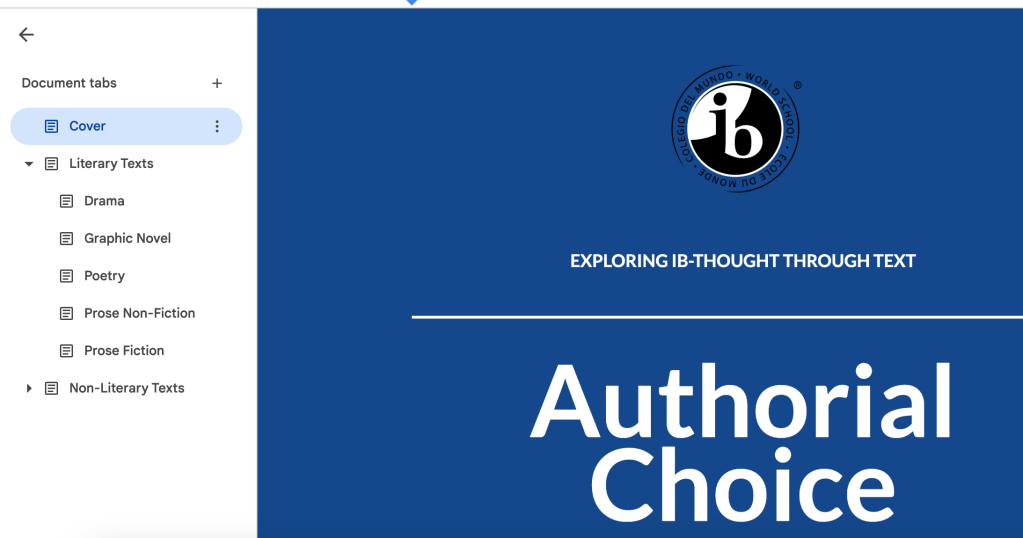
Authorial Choices Toolkit
Screenshot of the tabbed Google Doc structure.
Note. Tabs organize content into discrete sections to reduce cognitive load during independent use.
It also shaped my visual consistency across the course, using bolded fonts and stronger contrast to emphasize key concepts while avoiding unnecessary visuals. This same mindset shaped my LMS Google Classroom setup, where I turned off the stream, scheduled materials to post weekly, and built a clear directory for content and syllabus access, since a learner needs to be centered within the LMS itself and the content inside it.
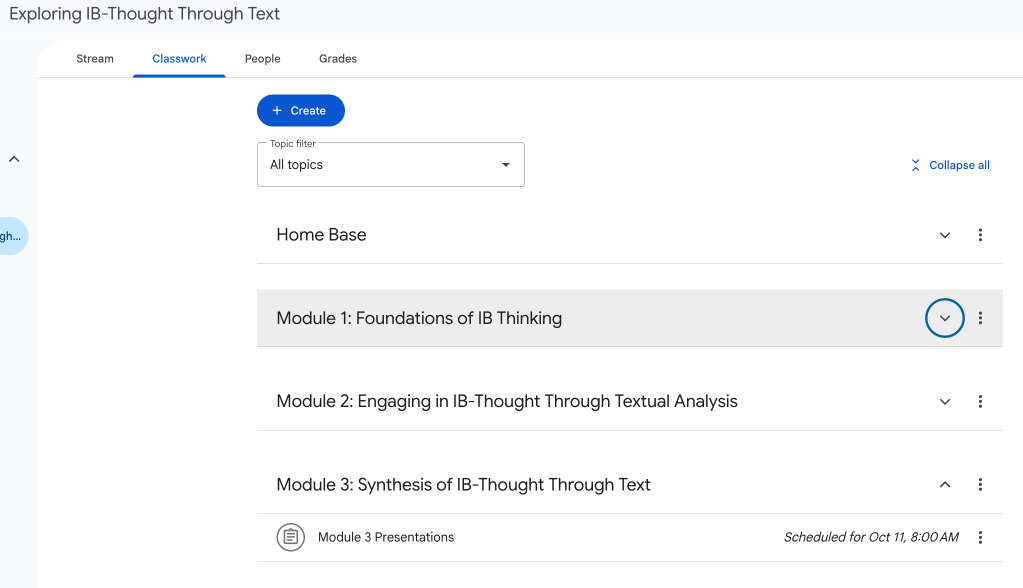
Google Classroom Course Setup
Screenshot of the course directory and scheduled posting structure.
Note. The classroom stream is disabled in favor of a fixed directory and weekly-scheduled materials.
Learning Through Struggle
The third part of my philosophy handles productive struggle, also known as failure-based learning. Learners shouldn’t struggle to access their work, but they should engage in struggle within that work.
Manu Kapur frames failure as an opportunity for “deeper learning” and not something that should be avoided in instructional design (Kapur, 2025). He also argues failure-based learning requires an appropriately calibrated challenge. In my work with my TAPAC interactive activity, I built a scaffolded sequence where students identify elements of a text before moving toward interpreting the meaning. I concentrated the struggle on the elements of a text because they are easy to fix but fundamental to the interpretation process. Anything that was answered incorrectly re-routed the students to try again and gave them specific feedback explaining why their answer was wrong.
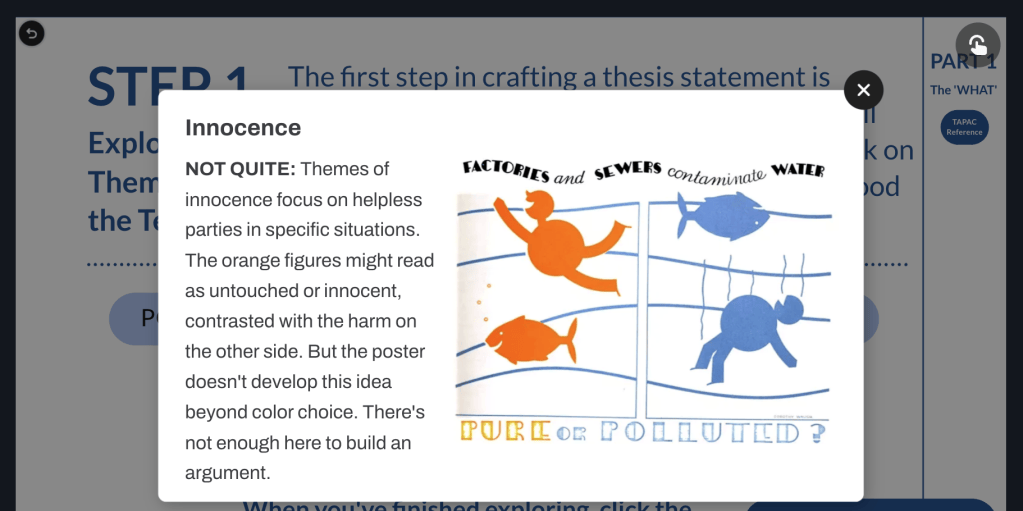
TAPAC Thesis Statement Scaffolded Sequence: Themes
Screenshot of the interactive activity showing the re-route and feedback mechanic for an incorrect response.
Note. Students receive targeted feedback and retry elements of text analysis before moving to interpretation.
For the second part of the activity I avoided failure-based learning because any theme statement and literary device they chose can be argued. Designing that aspect of the content around failure would imply there were only one correct answer which is the opposite intention of failure-based learning.
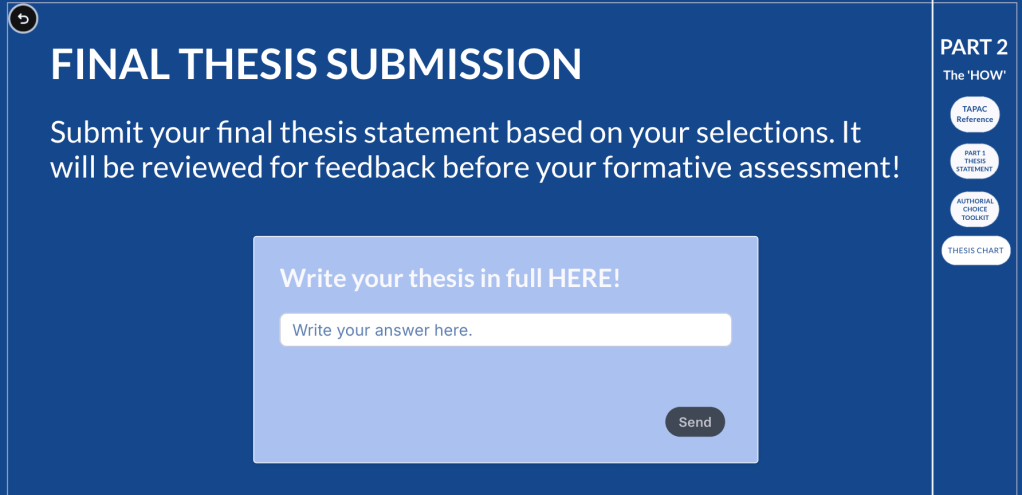
Final TAPAC Thesis Statement Submission
Screenshot of the open-ended thesis submission stage within the TAPAC interactive activity.
Note. Unlike the concept-identification stage, this step is not designed around failure, since a valid thesis can draw on more than one theme statement or literary device; the submission is reviewed for feedback rather than scored as correct or incorrect.
The contrast in how the activity is set up affirms Kapur’s argument that struggling with a problem before direct instruction produces deeper, more transferable understanding, but only when the struggle matches the learner’s task (Kapur, 2025). Knowing exactly where struggle should happen and designing for it is key in centering the learner.
Supporting Learner Variability
The fourth part of my philosophy, learner variability, is how I ensure that I can design for connection, manage cognitive load, and create opportunities for failure-based learning. I constantly work with accessibility softwares and materials like Grackle Docs and WCAG 2.1 guidelines to ensure all material is accessible. I use resources like Grackle to tag headers and complete contrast testing, specifically in my authorial choice toolkit. I also test resources using a screen reader and dyslexia-friendly fonts.
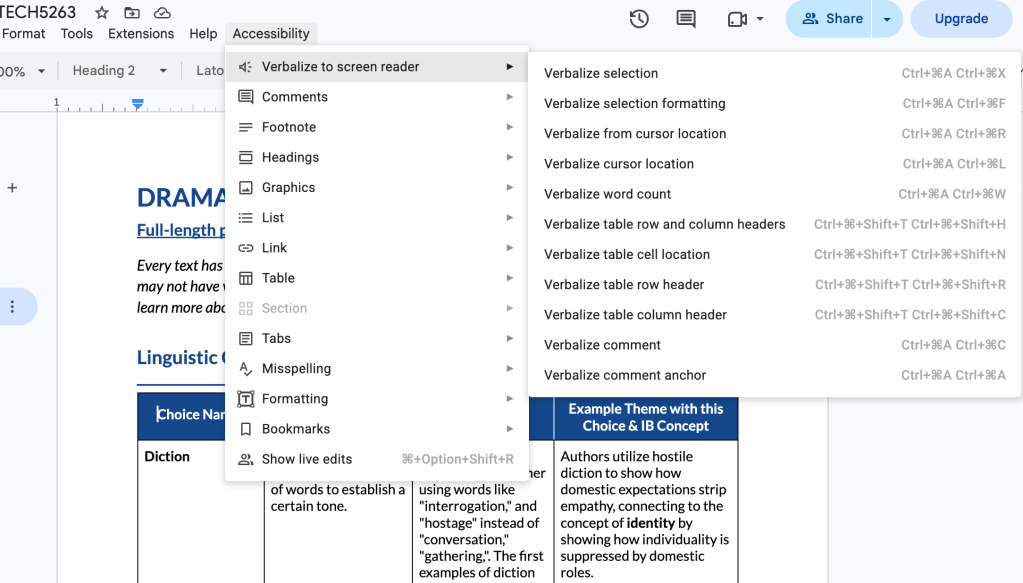
Accessibility Features in the Toolkit
Screenshot of tagged headers and accessibility for a screen reader
Note. Structural and visual accessibility features were tested to support learners using screen readers and contrast-sensitive viewing.
Learning about learner variability also changed how I think about what “designing for all” means. The UDL guidelines are at the core of accounting for learner variability. UDL argues that accessibility should be built into design from the start and not refined to include learners when an issue arises (CAST, 2024). UDL pushed me toward offering multiple ways to access and interact with information while still maintaining rigor and appropriate challenges. Instructional design is accessible design and if I want learners to meet all my other expectations, at the very least I need to ensure they’re supported too.
This same thinking shapes how I approach assessment. Learners need choice in their work, especially when the rigor is high and I constantly employ failure-based learning. In my pre-summative assessment activity, I allow students to choose which students to interact with, what concepts to discuss, and the texts they use to support their answers. The tasks itself also creates a scaffold for every learner while letting the commenting learner engage in reflective practices. Learner variability must be at the forefront of instructional design to comprehensively center the learner.
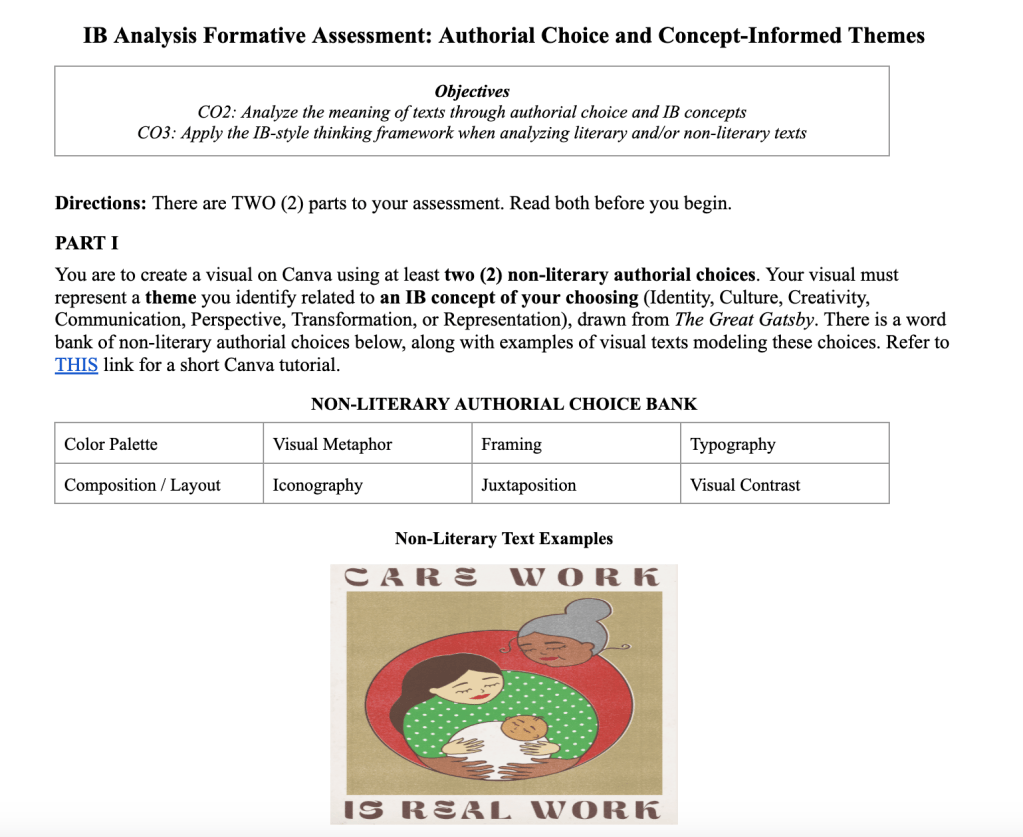
Module 2 Formative Assessment
Screenshot of Part I of the student-facing formative assessment with a student example.
Note. This formative task is the foundation for the peer-connected summative assessment.
Growth in Learning Design
As I continue this work, I plan to carry this philosophy forward by treating technology as a means of supporting the learner in their learning. Connection, cognitive load, productive struggle, and learner variability help illustrate my philosophy in practice, but represent my core belief that a designer must know their learner to create effective instruction. Growth in my professional work has meant learning to question my initial ideas and consolidate my thinking into a streamlined process.
As an M.Ed student focusing on adult and K-12 education, my learning philosophy of centering the learner stays consistent across both audiences. What changes is how I design for them. Malcolm Knowles argues that adult learners have engrained schemas, bring accumulated experiences and self direction into any learning environment (Knowles et al., 2020). Designing for this audience means weighing what I want to deliver against what a learner already believes. Adult learners must be treated as responsible for their own learning in a way a K-12 student might not be. Centering the learner in adult education requires the same focus on connection, load, struggle, and accessibility, because these core elements in my practice require me to know who’s in the room. As I move toward designing for K-12 and adult audiences, an andragogical and pedagogical understanding will allow me to build instruction all learners can effectively engage in.
References
CAST (2024). CAST Universal Design for Learning Guidelines version 3.0. Retrieved from https://udlguidelines.cast.org
Clark, R. C., & Mayer, R. E. (2023). E-learning and the science of instruction: Proven guidelines for consumers and designers of multimedia learning (5th ed.). Wiley.
Kapur, M. (2025). Productive failure: Unlocking deeper learning through the science of failing. Wiley.
Knowles, M. S., Holton, E. F., III, & Swanson, R. A. (2020). The adult learner: The definitive classic in adult education and human resource development (9th ed.). Routledge.
Siemens, G. (2005). Connectivism: A learning theory for the digital age. International Journal of Instructional Technology and Distance Learning, 2(1), 3–10.

